
The Lower Khyber Pass Stormwater Separation Project is part of Auckland’s wider programme to enhance stormwater resilience, reduce flooding, improve water quality, and relieve pressure on the wastewater network.
The project involves separating stormwater and wastewater systems and installing new stormwater pipelines beneath Lower Khyber Pass Road and surrounding streets.
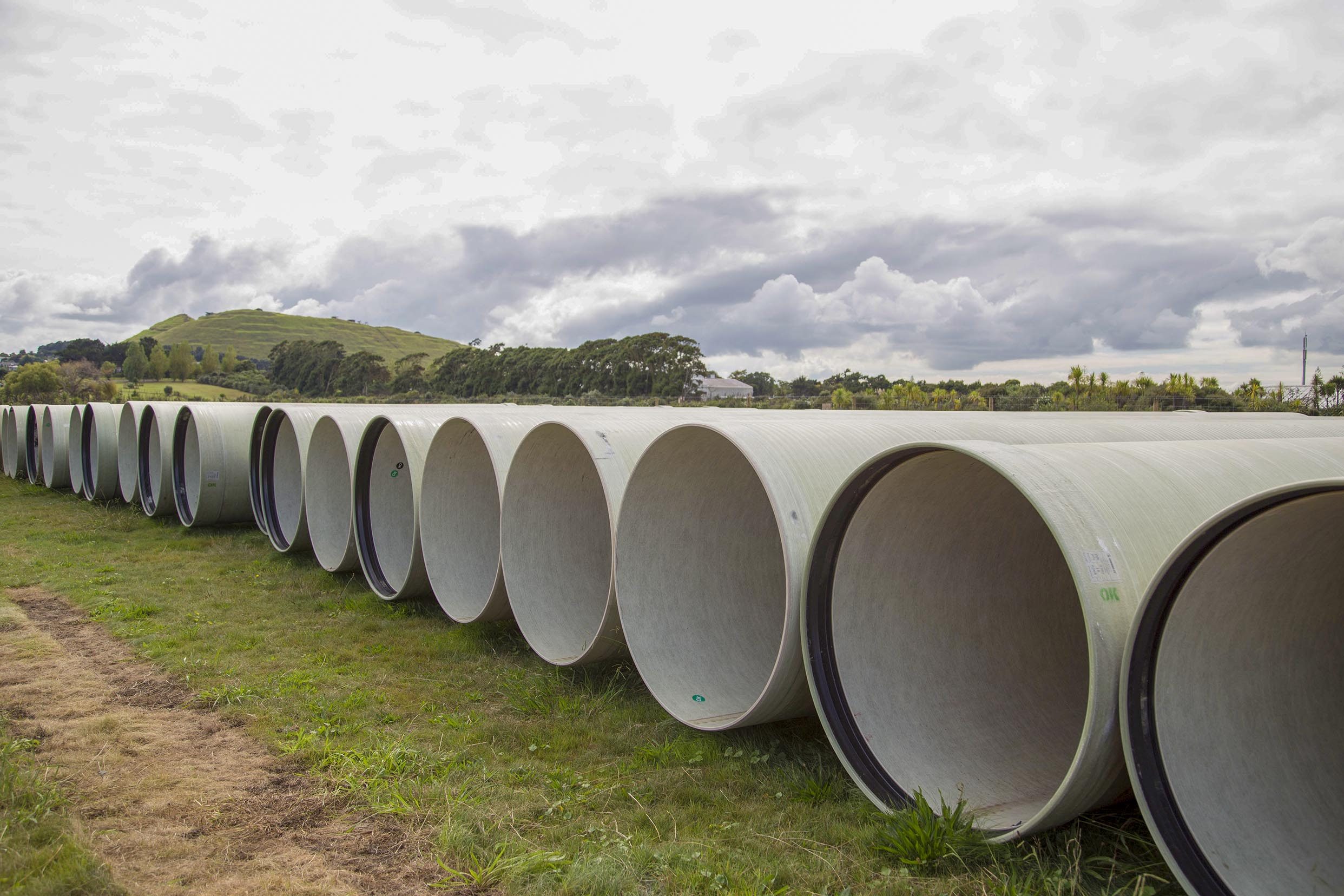
March Cato installed a new Glass Reinforced Pipe (GRP) stormwater pipeline using micro‑tunnelling technology. GRP was selected to suit the Tunnel Boring Machine (TBM) diameter, ground conditions, and the contractor’s methodology.

Hynds Pipes collaborated with March Cato to optimise the pipe’s structural design, working with a design jacking force of 500 tonne (which exceeded the planned jacking force). The 59 mm wall thickness reduced pipe weight and outside diameter, improving handling within the confined site and reducing drilling requirements.
The reduced OD and the GRP’s low external friction surface further decreased spoil, reduced TBM stress and operating costs, and supported longer pipe drives.
The 80 m pipeline was completed in a single pipe drive, tunnelling from the launch pit at Suiter Street through to the retrieval pit at Kingdon Street. Both pits utilized two manhole shafts, measuring 6 metre in diameter and 22 and 11 metres deep respectively.

Ground conditions included native soils, basalt, and East Coast Bay Formation (ECBF). March Cato chose to tunnel through the basalt layer rather than increase pit depth to reach softer material.
The location, within Newmarket’s busy retail precinct, required careful coordination of deliveries and site logistics. Once tunnelling commenced, uninterrupted progress was essential.